UX and research · Intermediate · 12 min
Map your assumptions and choose which to test first
By Padding · Updated 18 Nov 2026
Sticky notes or any online whiteboard, and a spreadsheet · November 2026
You will turn your team's guesses about a product into a ranked map and leave with the two or three riskiest assumptions, each written up as a test you can run.
On this page
Every product starts on guesses. Someone believes most people will book on their phone, someone else believes the main reason for missed appointments is forgetting, and the design quietly bakes those beliefs in. The trouble is not the guessing. It is that nobody wrote the guesses down, so nobody checked the one that would sink the project.
This tutorial gives you a short, repeatable routine: write every assumption as a statement, place each one on a grid of how much it matters against how much evidence you have, and pick the few in the danger corner. For each of those you write a test card, and the test cards become the questions in your research plan. You can do the whole thing in about an hour.
The running example is Larkfield Clinic, a fictional community clinic building an appointment booking app. A patient chooses a service, picks a time, enters their details, confirms and gets a reminder. The screens are Home, Choose a service, Pick a time, Your details, Confirm and Booked. Swap in your own product as you go.
Step 1 · Write every assumption as a "We believe" statement
Get the people who shape the product in one room or one call: a designer, someone who builds it, someone who knows the operation (for Larkfield, a receptionist or practice manager). Give everyone ten minutes to write alone, one assumption per sticky note or spreadsheet row. Writing alone first stops the loudest person setting the list.
Each note starts with "We believe" and makes one claim. Prompt people with four areas so the list does not end up all about the interface:
- Who: who uses it and in what situation. "We believe most bookings are made by the patient for themselves."
- Behaviour: what people do now and will do with the product. "We believe most patients will book on a phone."
- Value: why they would bother. "We believe people miss appointments mainly because they forget."
- Operations: what the organisation has to do for it to work. "We believe reception will keep the available slots up to date every day."
Then read the notes out and merge exact duplicates. Keep near-duplicates that say different things; "patients book on a phone" and "patients book on a shared family phone" lead to different designs.
Check it worked
You have at least 15 notes, every one starts with "We believe", and at least one note sits in each of the four areas. If the operations area is empty, ask the person closest to the front desk what has to be true on their side and add their answers.
Step 2 · Make each statement testable
A vague assumption cannot be ranked or tested. Go through the notes and fix three common faults:
- Two claims in one. "We believe patients book on a phone and want reminders by text" becomes two notes.
- No subject or no measure. "We believe the app will be easy" says nothing. Ask what would be easy, for whom, compared with what. It might become "We believe patients know which service to choose without asking reception."
- A solution dressed as an assumption. "We believe we need a calendar view" is a design decision. Ask what belief sits underneath it: "We believe patients have a specific day in mind before they open the app."
Add a short tag to each note for its area (Who, Behaviour, Value, Operations). It helps later when you check you are not testing only interface details.
Check it worked
Read each note aloud and ask, "Could we find out this is false?" Every note gets a yes. No note contains "and", and none names a screen element as the thing believed.
Step 3 · Draw the grid
Draw two axes on the whiteboard or on a large sheet of paper.
- Up the side, importance. Ask: if this is wrong, how much breaks? At the top, a wrong belief means rebuilding a core flow or the product failing its purpose. At the bottom, it means a small copy or layout change.
- Along the bottom, evidence. On the left, you have strong evidence: records, analytics, earlier research with real users. On the right, you have none, or only opinion.
That gives four areas. Label them so the team can talk about them by name.
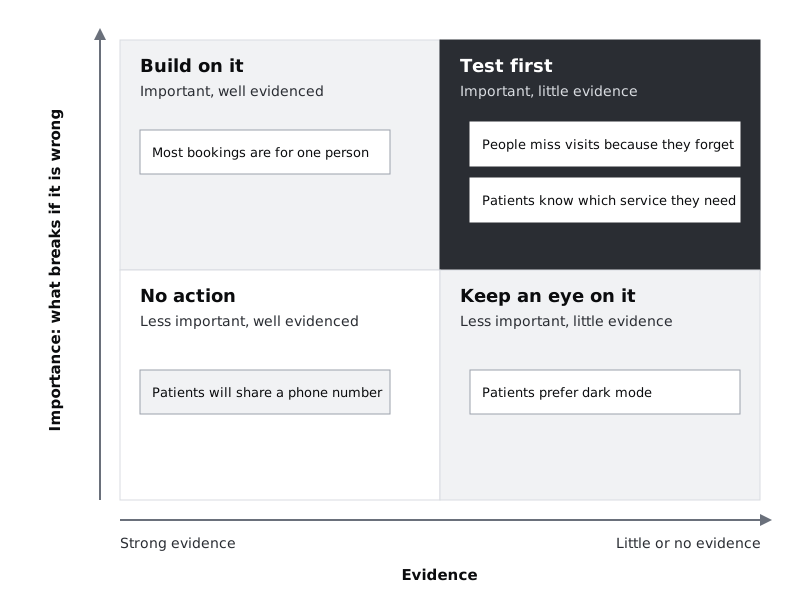
If you are working in a spreadsheet instead, add two columns, Importance and Evidence, and score each from 1 to 5. Then sort by importance minus evidence, highest first. The sort does the same job as the top-right corner.
Check it worked
Your grid has both axes labelled with the questions, not just the words "importance" and "evidence", and the four areas carry names. Someone walking past could tell which corner is the dangerous one.
Step 4 · Place each assumption against the others
Place the notes one at a time, out loud, and place them relative to each other rather than on an absolute scale. The question is "is this more or less important than the one we just placed?", not "is this a 7?". Comparisons are quicker and lead to fewer arguments.
For importance, ask which screens or decisions change if the note is false. At Larkfield, "people miss appointments mainly because they forget" sits high: if the real reason is that people cannot get time off work, a reminder solves little and the Booked screen needs a way to rebook or cancel instead. "Patients prefer dark mode" sits low.
For evidence, ask "what do we have?" and write the answer on the note in small letters: "front desk impression", "website analytics, Oct 2026", "none". Gut feeling from the team counts as no evidence, however experienced the person is. Evidence from a different service or a different country is weak at best.
Expect disagreement. If two people place a note far apart, that gap is useful information: it usually means one of them has evidence the other has not seen. Ask for it, and move the note if it holds up.
Check it worked
Every note is on the grid and carries a written evidence source, even if the source is "none". The notes are spread out across the grid; if most of them sit in one tight cluster, you scored them on an absolute scale, so move them again, comparing pairs.
Step 5 · Pick the two or three riskiest
Look at the top-right area. These are the beliefs your design depends on most and knows least about. Pick two or three to test now. More than three and the research stretches out until the team stops waiting for it.
If more than three notes sit in that corner, break the tie with two questions:
- Which decision comes first? Test the assumption behind the screen you will design soonest.
- Which is cheapest to check? A belief you can test with a week of front-desk tallies goes ahead of one that needs a month of interviews.
For Larkfield, the team picks three:
- We believe people miss appointments mainly because they forget.
- We believe patients know which service to choose without asking reception.
- We believe most patients will book on a phone.
Leave the rest where they are. Notes in the top-left area are your foundations; design on them, but keep the evidence source written down. Notes in the bottom-right area are worth a line in the research plan's "later" list, nothing more.
Check it worked
You have no more than three notes marked to test, all from the top-right area, and you can say in one sentence for each which screen or decision depends on it.
Step 6 · Write a test card for each
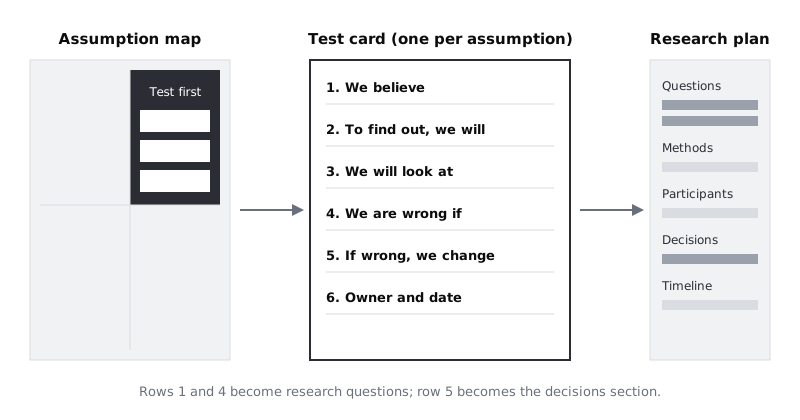
A test card turns a belief into a small piece of research with a result agreed in advance. Use one card per assumption, with six lines:
- We believe: the assumption, copied word for word.
- To find out, we will: the method, the people and how many.
- We will look at: the thing you count or listen for.
- We are wrong if: the result that would prove the belief false, written before you start.
- If wrong, we change: the screen, flow or decision that changes.
- Owner and date: one name and a date.
Line 4 matters most. If you write the threshold after you have the results, you will find a way to read them as a pass. Here is the first Larkfield card:
- We believe: people miss appointments mainly because they forget.
- To find out, we will: have reception call 10 patients who missed an appointment in the last month, using the clinic's usual consent and contact rules, and ask what happened.
- We will look at: the reason each person gives, grouped after the calls.
- We are wrong if: fewer than 5 of the 10 say they forgot.
- If wrong, we change: the Booked screen and reminder message, to lead with rebooking or cancelling rather than a plain reminder.
- Owner and date: practice manager, 2 December.
The second card tests service choice by giving eight people five short descriptions of a health need and the clinic's real list of service names, then asking them to pick one; the team is wrong if more than a quarter of the picks are wrong, and the fix is new names or a guided question on the Choose a service screen. The third checks the device split in the clinic website's analytics; the team is wrong if fewer than half of visits come from phones, and the fix is giving the desktop layout equal weight.
Check it worked
Each card has all six lines filled in, line 4 contains a number or a clear yes-or-no result, and line 5 names a real screen or decision. If you cannot fill in line 5, the assumption was not as important as you placed it; move it down and pick the next one.
Step 7 · Carry the cards into your research plan
The cards are the start of the research plan, not a separate document. Map them across:
- Lines 1 and 4 of each card become a research question and its success criterion.
- Lines 2 and 3 become the method and participants.
- Line 5 becomes the "decisions this research informs" section.
- Line 6 sets the timeline.
Photograph or export the grid and save it with the date beside the plan. When the tests come back, move the notes: a belief that held moves left (now evidenced), one that failed gets rewritten as a new statement and placed again. Run the map again at the start of the next design phase; the corner will hold different notes by then.
Check it worked
Your research plan draft has one question for each test card, each with the "we are wrong if" threshold next to it, and a dated picture of the grid sits in the same folder. Someone reading only the plan can see which beliefs it is testing and what changes if they are wrong.
Next steps
- Turn the riskiest assumptions into a full plan with Write a one-page research plan.
- If your list of assumptions felt thin, start upstream with Write how-might-we questions and come back to this grid with a sharper problem.
Part of these paths
Related tutorials
- Turn a problem statement into how-might-we questionsYou will have a sorted set of how-might-we questions drawn from one problem statement, with three workable questions chosen to explore and a note on why the rest were set aside.
- Write a one-page research planYou will have a research plan that fits on one page, with every question tied to a decision, and a stakeholder sign-off you got in a five-minute read.
Need this done for you?
Padding does this work for growing companies, from the first diagnosis to a system that keeps working.
Get new tutorials