UX and research · Beginner · 14 min
Build a persona from research data
By Padding · Updated 18 Nov 2026
Your interview notes, a spreadsheet and any document editor · November 2026
You will have two personas for Larkfield Clinic patients, each built from a group of interview participants who behave alike, with a source note against every line and no invented detail.
On this page
Most personas that teams ignore fail in the same way. Someone writes "Sarah, 34, marketing manager, loves yoga and oat lattes", adds a stock photo, and pins it to a wall. Nobody can say which of those details came from research, so nobody trusts any of them, and nobody can use them to settle an argument about a screen.
A persona earns its place when every line points back to something a real participant said or did. Then, when someone asks "do people really book for their whole family?", you can answer "four of eight participants did; here are the notes". This tutorial builds personas that way. You group participants by what they do and what they are trying to achieve, not by age or job title, write one persona per group, and tag each claim with its source.
The running example is Larkfield Clinic, a fictional community clinic planning an appointment booking app (Home, Choose a service, Pick a time, Your details, Confirm, Booked). The team has interviewed eight patients, P1 to P8, about how they book and attend appointments today. You will end with two evidence-based personas for Larkfield patients.
Step 1 · Number your notes so every claim can point somewhere
A source note is only useful if it leads to one specific observation. Before you analyse anything, give every note a short reference made of the participant code and a line number: P3-15 is the fifteenth note from participant 3. If your notes are in a document, number the paragraphs. If they are on sticky notes from an affinity session, write the reference in the corner of each one.
Keep the codes neutral. "P3" tells nobody the person's name, which matters when the persona document is shared outside the research team. The list that links codes to real people stays wherever your consent form says it must.
Then set up a spreadsheet with one row per participant and these first columns:
- Code: P1 to P8.
- Context: one line on their situation, only as much as you need. For example, "Books for two children and a mother with diabetes" or "Care worker on a rota that changes weekly".
- Notes: the range of references you have for them, such as P3-01 to P3-28.
Check it worked
Pick any participant and any note. You can find that note from its reference alone, in under a minute, without asking anyone. Your spreadsheet has one row per participant and no row contains a real name.
Step 2 · Choose behavioural variables, not demographics
A behavioural variable is a range along which participants differ in a way that changes what the product must do. "How far ahead they book" is one: someone who books three weeks ahead needs a different Pick a time screen from someone who books on the morning. "Age" is usually not one, because two 40-year-olds can book in completely different ways.
Read through your notes and list every way participants differed in what they did, wanted or worried about. Then write each as a range with two ends. For Larkfield, the list became:
- Who they book for: only themselves to several people.
- When they can attend: most weekdays to narrow, changing windows.
- How far ahead they book: weeks ahead to same day.
- Reliance on reminders: low to high.
- Changes after booking: rarely to often.
Aim for five to eight variables. Cut any that do not affect the design you are working on: "prefers a female doctor" may matter to the clinic, but if it does not change the booking flow, leave it for another project. Keep a demographic only when the notes show it drives behaviour, and then phrase it as the behaviour, not the demographic.
Add one column per variable to your spreadsheet.
Check it worked
Each variable in your sheet is written as a range with two named ends. Read each one aloud and finish the sentence "this changes the design because...". If you cannot finish it for a variable, delete that column.
Step 3 · Place every participant on every variable
For each participant, decide where they sit on each range and write a value from 1 (left end) to 5 (right end), with the note references that justify it in the same cell or a comment. P3 books for her two children and her mother, so "Who they book for" gets 5 with P3-03. P7 says "I find out my shifts on Friday for the week after", so "When they can attend" gets 5 with P7-06.
When the notes say nothing about a variable for someone, leave the cell empty. Do not guess from what similar participants said. A blank tells you something: either the question did not come up, or you need to ask in the next round.
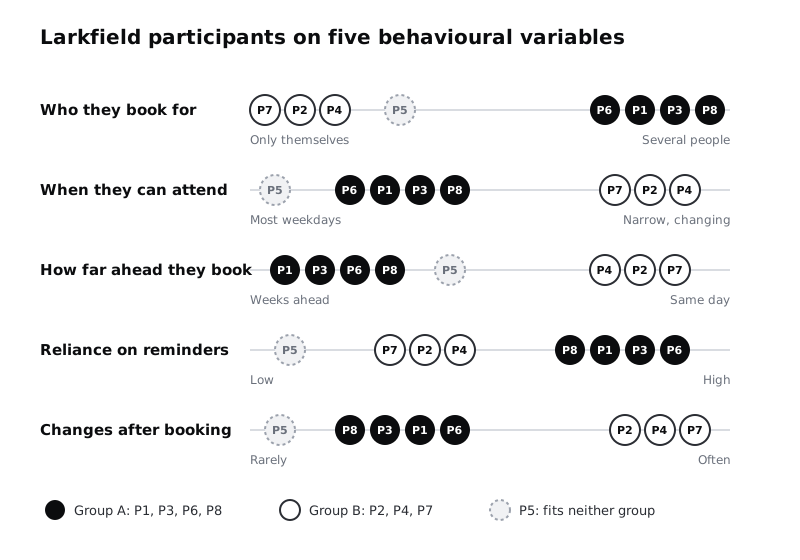
It helps to draw it. Put each variable on its own horizontal line and place a dot for each participant. Patterns that hide in a grid of numbers show up as clumps of dots.
Check it worked
Every filled cell in your sheet has at least one note reference next to the value. Count the empty cells: if any variable is blank for more than half the participants, you do not have enough evidence to use it, so remove it or mark it for follow-up.
Step 4 · Find the participants who move together
Look for participants who sit close together on several variables at once, not just one. Two people who both book for their families but differ on everything else are not a group. Three people who share the same position on three or four variables are.
At Larkfield, two groups appear:
- Group A (P1, P3, P6, P8) book for several people, book weeks ahead, lean heavily on reminders and rarely change a booking once made.
- Group B (P2, P4, P7) book for themselves, can only attend in narrow windows that change week to week, book a day or two ahead at most and often have to move an appointment.
P5, a retired man who books by phone and attends whenever offered, does not fit either group. Do not force him in. Note him as an outlier, with a line on why: "Only participant with no constraints on attendance; may represent patients who will keep using the phone." One outlier is not a persona, but it is a question for the next round of research.
Write each group in your sheet as a label and the list of participant codes. Then write, for each group, the two or three variables that define it.
Check it worked
Each group has at least three participants and shares a position on at least three variables. Every participant is either in exactly one group or listed as an outlier with a reason. No group is defined by an age band, job title or location.
Step 5 · Write the goals and behaviours for each group
Now turn the pattern into plain sentences. For each group, write four kinds of line, and put the source references at the end of each:
- Goal: what they are trying to achieve, in their terms. "Every appointment in the family kept, with no mix-ups (P1-07, P3-15, P8-04)."
- Behaviours: what they do today. "Copies each booking into a shared family calendar (P3-21, P6-14)."
- Frustrations: what goes wrong for them now. "Reminders do not say who the appointment is for (P1-19, P3-22, P6-17, P8-15)."
- Needs: what the product must do for them, drawn from the lines above. "See and change bookings for others from one place (P1-07, P3-15, P6-17)."
Use a rule for how much evidence a line needs. A good starting rule is that a line must be supported by at least two participants in the group, or by one participant plus something you observed directly. A line backed by one quote from one person goes into a separate "single source" list, not the persona.
Prefer what people did over what they said they would do. "Books one to three weeks ahead" from three people describing their last booking is stronger than "would use an app" from one person asked hypothetically.
Check it worked
Every sentence for each group ends in at least one reference, and most have two or more. You have a "single source" list, even if it is short, which shows you held lines back rather than letting everything in.
Step 6 · Assemble the persona and tag every line
Put each group's lines into a one-page persona. Keep it to one page so people read it. A usable layout is a header, then a table with three columns: type (goal, behaviour, frustration, need), claim, and source.
In the header, give the persona a short handle that describes the behaviour: "Adaeze, booking for the family" and "Tom, fitting it around shifts". Under it, write which participants it is based on and how many of the total that is, such as "Group A, based on P1, P3, P6, P8, 4 of 8 interviews". That line stops anyone treating the persona as the whole patient population.
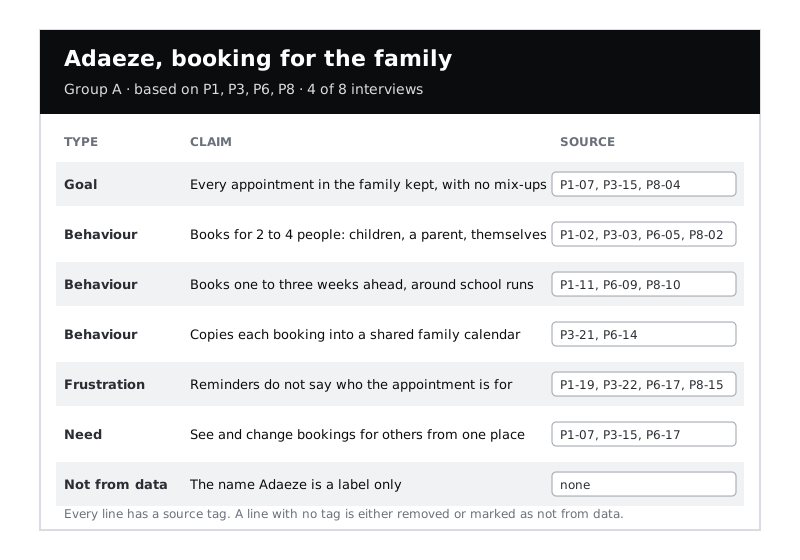
The name is the one line with no source. Say so in the persona itself, as the last row of the table: "Not from data: the name is a label only". A name makes the persona easy to refer to in meetings; it should not pretend to be a person.
Write the second persona, "Tom, fitting it around shifts", the same way from Group B's lines. Its goal might read "Get seen without losing a shift (P2-04, P4-09, P7-06)", and its needs will push the team towards early and late slots on Pick a time and a quick way to move a booking from Booked.
Check it worked
You have two personas, each on one page. Each has a header naming its participants and the share of the total, and a table where every row except the name has a source tag you can follow back to a note.
Step 7 · Remove what the data does not support
Read each persona line by line and ask one question: "Which note says this?" Delete anything that fails, however plausible it sounds. The usual culprits:
- Ages, jobs and locations added to make the persona feel real. If the notes show that working shifts drives Group B's behaviour, the behaviour line already says so; "Tom, 29, warehouse worker from the east side" adds nothing you can trace.
- Photos. A face carries an age, a gender, an ethnicity and a mood, none of which came from your data, and it shapes how people read every line under it. Use no image, or a plain initial.
- Personality and hobbies. "Organised and calm under pressure" sounds like evidence and is not.
- Quotes stitched from several people into one voice. Use a real quote with its reference, or none.
- Gendered pronouns in the claims, unless the group's notes support them. "Books for themselves and two others" works for any reader.
Then check the other direction: is anything strongly supported missing? If all four Group A participants mentioned reminders and the persona has no line about them, add one.
Check it worked
Do a final pass on each persona with a highlighter, digital or paper. Highlight every row with a source tag. The only unhighlighted text is the header and the "not from data" row for the name. If anything else is unhighlighted, it goes.
Step 8 · Record the limits and share the personas
Add three short lines under each persona's table before you share it:
- Based on: the number of interviews, when they were run and how participants were recruited. "8 interviews, October 2026, recruited from the clinic's waiting room and patient mailing list."
- Not covered: who your research did not reach. "No participants who need an interpreter or who have never used the clinic."
- Open questions: what the outliers and blank cells suggest. "Is P5 one of many phone-only patients? Ask in the next round."
Share the personas with the source sheet linked or attached, so anyone can check a claim. When the next round of research comes in, add the new participants to the same sheet and see whether they join a group, change one or form a new one. A persona that never changes after new research is a sign nobody is checking it.
Check it worked
Each persona has "Based on", "Not covered" and "Open questions" lines. A teammate who has not seen your notes can pick any claim, follow its reference in the shared sheet and find the note it came from.
Next steps
- Turn the patterns behind each group into insight statements the team can act on with Turn research themes into insight statements.
- Follow one persona through the clinic's current booking process in Map a current-state customer journey.
- If your notes are thin on how people actually work, gather more with Observe people at work with a contextual inquiry.
Part of these paths
Related tutorials
- Turn research themes into insight statementsYou will have five insight statements, each saying what people do, why they do it and what it means for the design, with quotes from several participants and a confidence level beside it.
- Map a current-state customer journeyYou will have a journey map of how patients book, attend and follow up on a clinic appointment today, with every pain point tied to the research that shows it and every guess marked as a guess.
Need this done for you?
Padding does this work for growing companies, from the first diagnosis to a system that keeps working.
Get new tutorials