UX and research · Beginner · 14 min
Build an affinity map from interview notes
By Padding · Updated 18 Nov 2026
Paper sticky notes and a wall, or any digital whiteboard, plus a spreadsheet · November 2026
You will turn the notes from five or six interviews into an affinity map of five to eight groups, each named as a finding and backed by notes from more than one participant.
On this page
After a round of interviews you have pages of notes and a head full of impressions. The impressions are the danger. The quote you remember best is usually the most dramatic one, not the most common, and the team ends up designing for the participant who talked loudest. An affinity map is a way to stop that: you break every set of notes into small pieces, then let the pieces sort themselves into groups based on what they say, before you decide what the groups mean.
The method is old and simple. What makes it work, or not, is two rules that are easy to skip. Each note holds one observation, so it can move on its own. And each group gets a name that states what you found, not the subject it is about. This tutorial spends most of its time on those two rules.
The running example continues from Run your first user interview: a team building an app that helps people in shared houses split bills. They interviewed six housemates, P01 to P06, on the question "How do housemates decide who pays for what, and where does it break down?" Use your own notes in place of theirs.
You can work on paper or on screen. Paper on a wall is fast and makes it easy for two people to work side by side. A digital whiteboard is better if your team is remote or you need to keep the map for months. The steps are the same either way.
Step 1 · Pull out one observation per note
Go through each participant's notes in turn and write each separate observation on its own sticky note. An observation is one thing the participant said, did or showed you. It is not your interpretation of it.
Use these rules for every note:
- One idea only. If a sentence has "and" or "but" joining two points, it is two notes.
- Stand-alone. Someone who was not in the session must understand the note without context. "She hated it" fails; "P03 hated chasing housemates for money on WhatsApp" works.
- Their words or their actions, not your conclusions. "P05 keeps a paper list on the fridge of who owes what" is an observation. "P05 needs a better tracking tool" is a conclusion, and it has no place on a note yet.
- Participant code on every note. Write P01, P02 and so on in a corner. Without it you cannot tell later whether a group has five participants in it or one participant said the same thing five times.
- Short. Aim for under 15 words, so a group of notes can be read at a glance.
Quotes are welcome. Put them in quotation marks so you can tell them apart from paraphrase, for example: P02 "I'd rather pay the extra than have the conversation".
Leave out anything that does not bear on the research question, such as small talk or opinions on unrelated apps. If you are unsure, write the note; it is cheaper to discard it later than to go back to the recording.
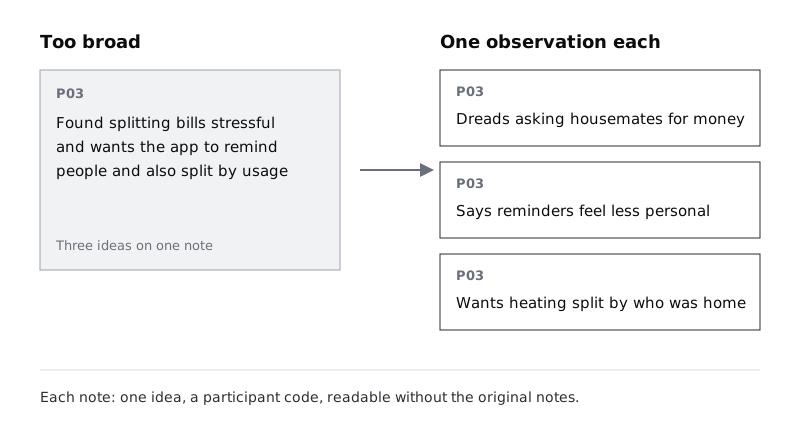
Expect somewhere between 30 and 60 notes per interview hour. Six interviews will give you a few hundred notes. That is normal.
Check it worked
Pick ten notes at random. Every one has a participant code, holds one idea, and makes sense to you without opening the original notes. If more than two fail, go back and split or rewrite before you move on; problems here get harder to fix once notes are grouped.
Step 2 · Mix the notes and set up the space
Shuffle all the notes together so they are no longer sorted by participant. On a wall, stick them up in loose rows in any order. On a digital whiteboard, select all of them and drag them into one big unsorted area on the left, leaving plenty of empty space on the right for groups.
Mixing matters. If P01's notes all sit together, you will end up with a group that is really "what P01 said", which tells you nothing about patterns across people.
If you have a colleague with you, agree two working rules before you start:
- Silent sort first. For the first 20 to 30 minutes, nobody explains or argues; you both just move notes. Talking too early lets the most confident person set the groups.
- Anyone can move any note. If you disagree with where a note sits, move it. If it keeps bouncing between two groups, make a copy and put one in each.
Check it worked
Look at any patch of the unsorted area. Notes from at least three different participant codes sit next to each other, and there is empty space ready for groups.
Step 3 · Cluster from the bottom up
Take one note and read it. Take the next and ask: "Does this say something similar to the first one?" If yes, put them together. If no, start a new pile. Keep going note by note.
Work from the notes upwards. Do not write a list of categories first ("Payments", "Communication", "Trust") and then sort notes into them. Those categories come from your assumptions, and you will force notes into them that do not fit. Groups should form because notes resemble each other, not because you planned a box for them.
Some guidance as piles grow:
- Group by meaning, not by keyword. "P04 pays the internet bill and never gets paid back" and "P06 stopped buying shared toilet roll after nobody paid her" do not share a word, but both are about one person carrying a cost that others do not repay. They belong together.
- Small piles are fine. Early on you might have 30 piles of two or three notes. That is normal; they merge in the next step.
- Keep a parking area. Notes that fit nowhere go to one side. Do not force them. Some will find a home later; a few will stay odd, and that is useful too.
For the bill-splitting team, early piles included notes about who sets up direct debits, notes about awkward conversations, notes about rough versus exact splitting, and a scatter of notes about specific banking apps.
Check it worked
Every note is either in a pile or in the parking area. No pile has been named yet. If you find you have a label on any pile, remove it for now.
Step 4 · Merge and split until the groups hold
Now read through the piles and look for ones that say the same thing at a higher level. Merge them. Then look for piles that have grown large and check whether they really make one point or two. Split those.
Go round this loop a few times. You are aiming for five to eight groups of roughly 8 to 30 notes each. That range is a working target, not a law: fewer than five usually means the groups are too broad to act on, and more than eight is hard for a team to hold in mind.
Two checks help at this stage:
- Spread across participants. Count the distinct participant codes in each group. A group with notes from only one person is an anecdote, however vivid. Keep it in view, but do not treat it as a pattern. A group with notes from four of six participants is worth attention.
- Contradictions. If a group holds notes that point in opposite directions (some housemates love exact splitting, others find it petty), it may be two groups, or it may be the finding itself: "Housemates disagree on how exact a split should be." Decide which, rather than averaging it away.
A spreadsheet makes the counting easy. Give each note a row with three columns: the note text, the participant code and the group. A pivot table or a quick count per group shows how many notes and how many distinct participants each group has.
Check it worked
You have five to eight groups. For each one you can say, without looking, roughly what its notes have in common. Your count shows the number of distinct participants per group, and at least half the groups include three or more participants.
Step 5 · Name each group as a finding
This is the step that turns a sorted wall into something a team can use. Write a label for each group that states what you found, as a full sentence, in plain words. Do not name the subject.
Compare these pairs. The topic label comes first; the finding label after the arrow is the one to use:
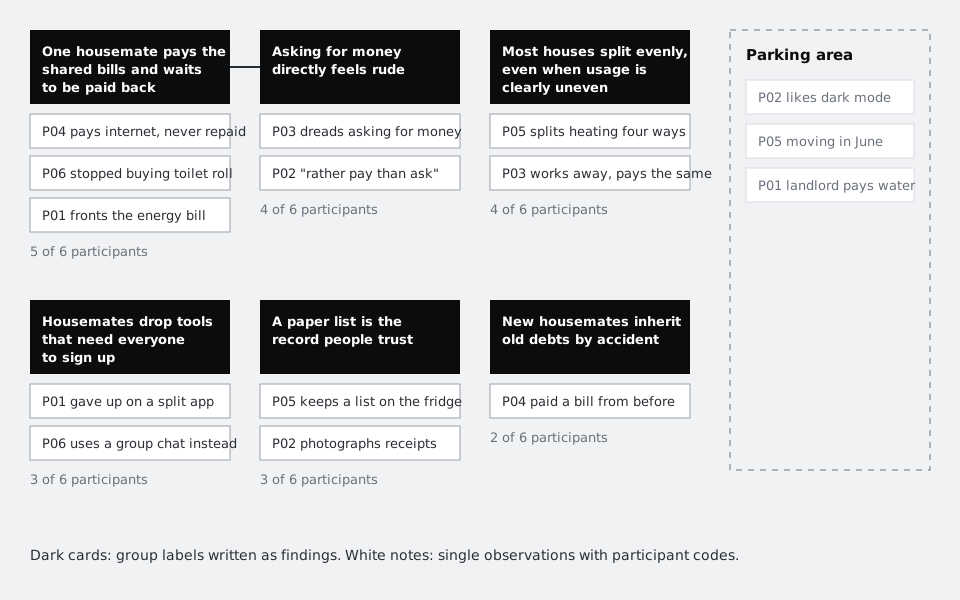
- Payments → One housemate usually pays the shared bills and waits to be paid back
- Communication → People avoid asking for money directly because it feels rude
- Splitting methods → Most houses split evenly, even when usage is clearly uneven
- Apps → Housemates already use two or three tools and drop any that need everyone to sign up
A topic label tells you where to look. A finding label tells you what is true, and it can be wrong, which is the point: the team can check it against the notes beneath it and argue with it.
Write each label from the notes in the group, not from what you expected to find. Read every note in the group before you write the label. If the label only fits half the notes, the group needs splitting, so go back a step.
Use the participants' own words in labels where you can. "Asking for money feels rude" is closer to what people said than "Financial communication friction".
Check it worked
Read each label aloud. Every one is a full sentence that someone could disagree with. None is a single noun or a noun phrase such as "Trust issues". Someone who has not seen the notes can tell from the labels alone what the research found.
Step 6 · Look for patterns across groups
With the groups named, step back and look at the whole map. Groups often connect. The bill-splitting team noticed that "Asking for money directly feels rude" sat beside "One housemate pays the shared bills and waits to be paid back". The second follows from the first: because asking feels rude, the person who pays absorbs the cost rather than chase it.
Draw arrows or write a short note between groups when you see a link like that: one causes another, one is a workaround for another, or two contradict each other. Also look for gaps. If nobody mentioned something the team assumed was central (for example, nobody talked about splitting rent, only bills), write that down too; absence is a finding.
Then deal with the parking area. Read the leftover notes. Some will now fit a group. Leave the rest, and add a line to your summary saying what they were about, so they are not lost.
Check it worked
You have at least one written link between two groups, stated as a sentence. The parking area has been reviewed and either emptied or listed in a short note.
Step 7 · Record the map so it lasts
A wall of sticky notes comes down; a whiteboard gets cluttered. Record the result while it is fresh.
- Photograph or export the whole map, then a close-up of each group so the notes are readable.
- Update the spreadsheet so every note row has its final group name. This becomes your source when someone asks "how many people said that?" in three weeks.
- Write a one-page summary: the research question, the number of participants, the group labels in order of how many participants support them, with two or three quotes under each, the links between groups and anything notable from the parking area.
Keep participant codes, not names, in everything you share. The map is evidence; the next job is to turn its groups into insight statements the team can design from.
Check it worked
You have a one-page summary listing five to eight finding labels, each with a participant count such as "4 of 6" and at least two quotes. The spreadsheet has a group filled in for every note row, and a colleague can open the summary and understand it without having seen the map.
Next steps
- Turn the strongest groups into insight statements with Turn research themes into insight statements.
- If your notes were thin or inconsistent, tighten the next round with Run your first user interview.
- Check your next guide does not plant the answers you hope to find, using Write an interview guide without leading questions.
- Use the finished groups as raw material for Build a persona from research data.
Part of these paths
Related tutorials
- Run your first user interviewYou will run a 45-minute one-to-one interview with a note-taker beside you and finish with a recording, a page of structured notes and a five-line debrief written within the hour.
- Turn research themes into insight statementsYou will have five insight statements, each saying what people do, why they do it and what it means for the design, with quotes from several participants and a confidence level beside it.
Need this done for you?
Padding does this work for growing companies, from the first diagnosis to a system that keeps working.
Get new tutorials