Product and project management · Beginner · 13 min
Build a now, next, later roadmap around outcomes
By Padding · Updated 18 Nov 2026
Any slide or whiteboard tool · November 2026
You will turn a pile of feature requests into a one-page roadmap of problems and outcomes in three columns, with an owner on every current item and dates only where a contract or rule demands them.
On this page
Most roadmaps start life as a list of features with a date next to each one. They look reassuring, and they go wrong quietly. The dates were guesses, but readers treat them as promises. The features were someone's idea of a fix, but nobody wrote down what they were meant to fix, so when one ships nobody can say whether it worked.
A now, next, later roadmap swaps both of those for something you can stand behind. It has three columns instead of a calendar. Each item is a problem worth solving and the outcome that should move when it is solved, not a feature. The columns say how sure you are: the left column is work under way, the middle is shaped but not started, the right is direction only. The format is usually credited to Janna Bastow, co-founder of ProdPad, who designed it as an alternative to date-based roadmaps.
The running example is Larkfield Clinic, a fictional community clinic that is moving to online booking and appointment reminders. Its board meets every month and wants to know what the small product team is doing and why. You will build the one page they read. Use your own product if you have one; the steps are the same.
Step 1 · Turn every request into a problem
Collect every request, idea and complaint about the product in one list. For Larkfield, that came from the clinic manager, reception staff, two GPs and patient feedback:
- "Add text reminders"
- "Let patients book online"
- "Online cancellation button"
- "Move off the old booking server"
- "Faster sign-up for new patients"
- "Reminders in other languages"
- "Let carers book for the people they look after"
- "Online repeat prescriptions"
Every line is a solution. Rewrite each one as the problem behind it, in the form "who struggles with what". Ask the person who suggested it "what goes wrong today without this?" if you are not sure.
- "Add text reminders" becomes: Patients forget appointments and do not turn up.
- "Let patients book online" becomes: Patients can only book by phone, and the lines jam at 8am.
- "Online cancellation button" becomes: Patients who cannot come have to phone to cancel, so many do not.
- "Move off the old booking server" becomes: Booking records sit on a server that is losing support.
- "Faster sign-up for new patients" becomes: New patients wait days before they can book a first appointment.
- "Reminders in other languages" becomes: Patients who read little English may not understand reminders.
- "Let carers book for the people they look after" becomes: Carers have to phone to book for the people they look after.
- "Online repeat prescriptions" becomes: Repeat prescription requests tie up the phone lines.
Several requests often share one problem. Merge them when they do. Keep the original request next to the problem so the person who asked can see it was heard.
Check it worked
You have a list of problems in which every line names a group of people and something that goes wrong for them. Read only the problem half of each line: none mentions a button, a screen, an app or any other solution.
Step 2 · Name the outcome each problem should move
For each problem, write the change you would see if it were solved. An outcome is a measurable change in what people do or experience, not something the team delivers. "Reminders sent" is output. "Fewer missed appointments" is an outcome.
Write each outcome as a metric and a direction, and add the current figure where you have one:
- Patients forget appointments: missed-appointment rate, 7.2% in October, target below 5%.
- Patients can only book by phone: share of GP bookings made online, 0% today, target 20%.
- Cancelling means a phone call: share of cancellations made without phoning.
- Booking records on an unsupported server: number of records left on it, target zero.
- New patients wait to register: days from registration request to first booking.
- Reminders only in English: share of patients who say they understood the reminder.
- Carers book by phone: share of carer bookings made online.
- Repeat prescriptions tie up lines: prescription calls per week.
If your product has a North Star metric, check that most outcomes feed it. Larkfield's is online bookings attended: appointments booked or rebooked in the app where the patient turned up. Online booking and online cancellation feed it directly. SMS reminders help attendance, but they only partly move this metric, because most reminded appointments were booked by phone. An outcome that feeds nothing is worth a second look: it may still matter (the server move does), but you should be able to say why.
You do not need a baseline for every item yet. Items far in the future can carry an outcome in a few words; you will add numbers when they move closer.
Check it worked
Every problem on your list now has an outcome next to it, and each outcome names something you could count. Read each one and ask "could the team ship something and this still not change?". If the answer is no, you have written an output, so rewrite it.
Step 3 · Decide what each column means
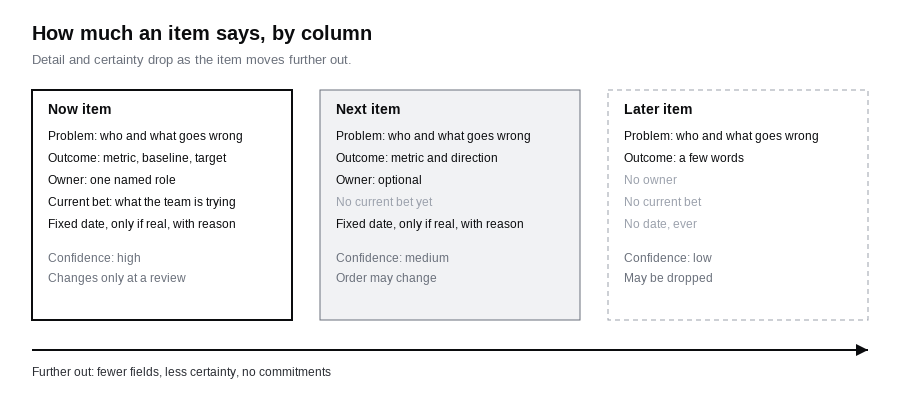
Before you sort anything, write down what the three columns mean for your team. Each column has a rough time horizon and a level of confidence. Pick horizons that match how far ahead your team can see. For a small team like Larkfield's, which plans in two-week sprints, these work:
- Now: roughly the next three months (December to February). The team is working on these, or will start within weeks. High confidence.
- Next: roughly three to nine months out (March to August). The problem is understood and the team expects to take it on, but the approach and order may change. Medium confidence.
- Later: beyond that. Problems you believe matter, kept visible so nobody forgets them. Low confidence; any of them may be dropped.
A team shipping weekly might use one month, one quarter and beyond. A team on a long hardware cycle might use a quarter, a year and beyond. What matters is that the columns get wider and less certain as they go right, and that every reader knows it.
Write these definitions at the top of each column, short enough to read at a glance. They are the part of the roadmap that stops a reader mistaking Later for a promise.
Check it worked
Your slide or board has three columns headed Now, Next and Later, and under each heading is a time range and a confidence word (high, medium, low). Someone who has never seen a roadmap like this could read the headings and tell you which column the team is working on today.
Step 4 · Sort the problems into columns
Place each problem in a column. Start with Now, because it is the hardest to fill honestly.
Now is limited by the people you have. Count the problems the team can work on at the same time without everything slowing down. For Larkfield, with one developer, a product lead and part of the reception lead's week, that is two. A team of eight might manage three or four. If Now holds more than the team can work on, the extra items are not really Now; they are waiting, and the roadmap is hiding it.
For Larkfield:
- Now: patients forget appointments; booking records on an unsupported server.
- Next: patients can only book by phone; cancelling means a phone call; new patients wait to register.
- Later: reminders only in English; carers book by phone; repeat prescriptions tie up lines.
Use whatever ranking you already have to decide the order. If you scored the backlog with RICE or another method, the scores help here. If not, ask of each item: how many people does it hurt, how badly, and what do we learn by doing it first? Reminders went into Now ahead of online booking because the trial is small, the cost of missed appointments is high, and the result tells the clinic how patients respond to texts before it builds anything bigger.
Leave Later short. Eight or ten items is plenty. A Later column with forty items is a wish list, and it makes the board feel every idea has been accepted.
Check it worked
Count the items in Now. The number is no more than the number of problems your team can work on at the same time, and you can say who is doing each one. Later has no more than about ten items.
Step 5 · Mark the dates that are real commitments
This roadmap has no timeline, but some dates are real and hiding them would be dishonest. A date is a real commitment when missing it has a consequence outside the team: a contract ends, a regulation takes effect, a funder's reporting deadline arrives, a partner launches on a fixed day. A date is not a commitment just because someone senior would like the work done by then.
Test each date with one question: "What happens, and to whom, if we miss it?" If the answer is "someone is disappointed", it is a target, not a commitment, and it stays off the roadmap. If the answer is "the clinic loses support for its booking records" or "the clinic breaks a rule it must follow", it goes on.
Larkfield has two:
- The old booking server's support contract ends on 28 February 2027. After that, there are no security fixes. This is in Now.
- The (fictional) regional health board requires every clinic to let patients cancel without phoning by 1 July 2027. This is in Next.
Show a fixed date as a tag on the item, not as a position on a time axis. The tag carries three things: the word FIXED, the date, and the reason in a few words. "FIXED 28 Feb 2027 · support contract ends" tells the board why this date cannot move and where to look if they doubt it. Keep the source of each date (the contract, the regulator's notice) linked in your notes.
If a fixed date sits in Next, check that there is enough time between the start of Next and the date to do the work. If there is not, the item belongs in Now.
Nothing in Later gets a date. If something far off has a real deadline, it is not Later; move it left and plan for it.
Check it worked
Every date on your roadmap is attached to an item as a tag that names its reason, and you can point to the contract, rule or agreement behind it. The Later column contains no dates at all.
Step 6 · Give each Now item an owner and a current bet
For each Now item, add two more lines:
- Owner: the one role who answers for whether the outcome moves. Not a team and not "product"; one person, by role or name.
- Current bet: what the team is trying right now to move the outcome, in a few words.
For Larkfield:
Patients forget appointments. Outcome: missed-appointment rate, 7.2% to below 5%. Owner: product lead. Current bet: 12-week SMS reminder trial from 6 January.
Booking records sit on a server that is losing support. Outcome: no booking records left on the old server. Owner: practice manager. Current bet: move records to the new booking system's hosting. FIXED 28 Feb 2027 · support contract ends.
The bet is the only place a solution appears on the roadmap, and only in Now, because only there has the team chosen one. Writing it as a bet reminds everyone it can be swapped. If the SMS trial does not move the rate, the problem stays in Now and the bet changes.
Next items can carry an owner if one has been agreed. Later items do not need one.
Check it worked
Read down the Now column. Every item names an outcome with a target and exactly one owner. Ask each owner whether they agree to the outcome next to their name; each has said yes.
Step 7 · Lay it out on one page for the board
Put everything on one slide or one board frame. At the top, add a title, the date this version was made, the date of the next review, and who maintains the roadmap. Under the columns, add two lines that tell readers how to read it: confidence falls from left to right, and only items marked FIXED carry a date.
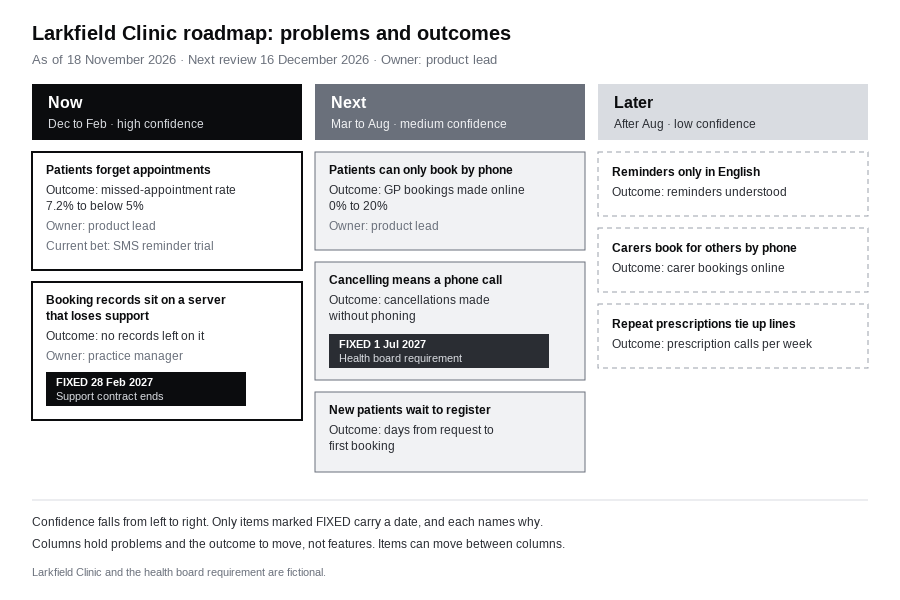
Make the columns look different in weight. Solid borders for Now, lighter fills for Next, dashed or faint borders for Later. Readers then see the drop in confidence before they read a word.
Many board members will open this on a phone, and some will be on prepaid mobile data or older Android handsets, which is common for clinic boards across Africa and elsewhere. Export the page as a single PDF or image, check it is well under 1 MB, and zoom out on a phone to make sure the item titles are still readable. If your board works in more than one language, agree which language the roadmap is in and keep item titles short enough to translate.
Then test it. Give the page to someone who has not seen it, such as a board member or a colleague outside the team, and ask three questions:
- What is the team working on right now, and how will we know it worked?
- Which dates can we not move, and why?
- What might the team do after the summer?
If they answer the first two correctly and say "maybe" to the third, the page works.
Check it worked
Your roadmap fits on one page and shows a version date and a next review date. Every item in Now names an outcome and an owner. Nothing in Later has a date. A first-time reader answered the three questions above without asking you anything.
Next steps
The page you have is a snapshot. Plans will change within weeks, and the roadmap is only useful if it changes with them.
- Keep a roadmap honest when plans change to run a monthly review when plans change, using a Larkfield roadmap six weeks on.
- Choose a North Star metric and its input metrics to check that your outcomes feed one measure of value.
- Prioritise a backlog with RICE scores to sort problems into columns with numbers rather than instinct.
- Write a one-pager that gets a feature approved to get a yes on the bet behind a Now item.
Related tutorials
- Write user stories with clear acceptance criteriaYou will have five user stories for a clinic's reschedule feature, each checked against INVEST and carrying Given / When / Then acceptance criteria that a developer and a tester read the same way.
- Write tickets developers want to pick upYou will rewrite three vague backlog tickets into ones a developer can start without asking a question, and save the structure as a ticket template in your tracker.
- Write a weekly stakeholder update people readYou will have a reusable weekly update template and one finished update under 250 words, whose first two lines tell any reader whether they need to act.
Need this done for you?
Padding does this work for growing companies, from the first diagnosis to a system that keeps working.
Get new tutorials