AI in design · Beginner · 14 min
Draft research questions with AI and review them for bias
By Padding · Updated 18 Nov 2026
Any general-purpose AI chat assistant and a document editor · November 2026
You will have an interview guide that started as an AI draft, with every question reviewed for leading wording, double questions, assumptions and jargon, the failures rewritten by you, and a tally of how many AI questions survived unchanged.
On this page
An AI assistant will give you twelve interview questions in a few seconds. They will be grammatical, on topic and confident. Some will be fine. Others will put an answer in the participant's mouth, ask two things at once, assume a life the participant does not have, or use a word only the clinic's staff would know. Those faults are easy to miss because the draft reads so smoothly.
The fix is not to avoid AI, and not to trust it. Treat the output as a first draft written by a keen colleague who has never met your users, and give it the same bias review you would give any draft. This tutorial walks through that review question by question, so the faults are caught on paper rather than discovered in the middle of an interview.
The running example is Larkfield Clinic, a fictional community clinic building an appointment booking app. Too many patients miss appointments, and the team wants to understand why before designing anything. You will ask an AI assistant for interview questions about missed appointments, review each one against four checks, rewrite the ones that fail, and finish with a reviewed guide and a tally: how many of the AI's questions survived unchanged, how many you rewrote and how many you cut.
Step 1 · Write a brief the assistant can work from
Open a new document and call it "Larkfield missed appointments, question review". At the top, write the brief you will give the assistant. A vague prompt ("give me interview questions about missed appointments") gets generic questions, so say who you are talking to, what you need to learn and what to avoid.
I'm planning 45-minute interviews with patients of a small community
clinic. The clinic is designing an appointment booking app.

What we need to learn:
1. What happens in the days before a patient misses an appointment?
2. How do patients find out they have missed one, and what do they do next?
3. How do patients book and keep track of appointments today?

Participants: adults who have missed or moved at least one appointment in
the last six months. Some book for children or older parents. Not all of
them own a smartphone, and some speak English as a second language.

Write 12 open interview questions. Ask about specific past experiences,
not opinions or predictions. Do not mention the app.
Do not paste anything that identifies a real person: no names, phone numbers, appointment records or notes from earlier interviews. The brief only needs the research questions and a general description of the participants. If you do want to share research material with an AI tool later, read /tutorials/remove-personal-data-before-sharing-research-with-ai first.
Check it worked
Your brief names the research questions, describes the participants in general terms and sets the format (number of questions, open, past experience). Search it for any real name, number or date of birth: there are none.
Step 2 · Get the draft and keep it exactly as it came
Paste the brief into your AI assistant and send it. Copy the reply into your document under a heading "AI draft, unedited", and write the date and the tool you used underneath. Number the questions 1 to 12 if the assistant did not.
Do not tidy anything yet. The unedited draft is your baseline: without it, you cannot count what survived, and you will half-remember the AI's questions as better than they were. Your draft will differ from the one below, because the same brief gives different answers on different days and in different tools. The faults tend to be the same kinds, though. Here is a draft of the sort you can expect, used for the rest of this tutorial:
- How often do you miss medical appointments?
- Wouldn't a reminder text help you remember your appointments?
- What are the main barriers that prevent you from attending your scheduled appointments?
- Can you tell me about the last time you missed or nearly missed an appointment?
- How did you book that appointment, and how did the clinic remind you about it?
- How frustrating is it when you can't get through to the clinic on the phone?
- Would you use an app that lets you cancel and rebook in a few taps?
- What happened after you realised you had missed it?
- How do you usually get to the clinic?
- Do you think the clinic's DNA policy is fair?
- What role does your work schedule play in missed appointments?
- Who else, if anyone, do you book appointments for?
Notice question 7. The brief said not to mention the app, and the draft mentions it anyway. Instructions in a prompt shape the output; they do not guarantee it. That is the first reason every question needs a human read.
Check it worked
Your document has a section "AI draft, unedited" with twelve numbered questions, the date and the tool name. Nothing in it has been changed from what the assistant wrote.
Step 3 · Set up a review table with four checks
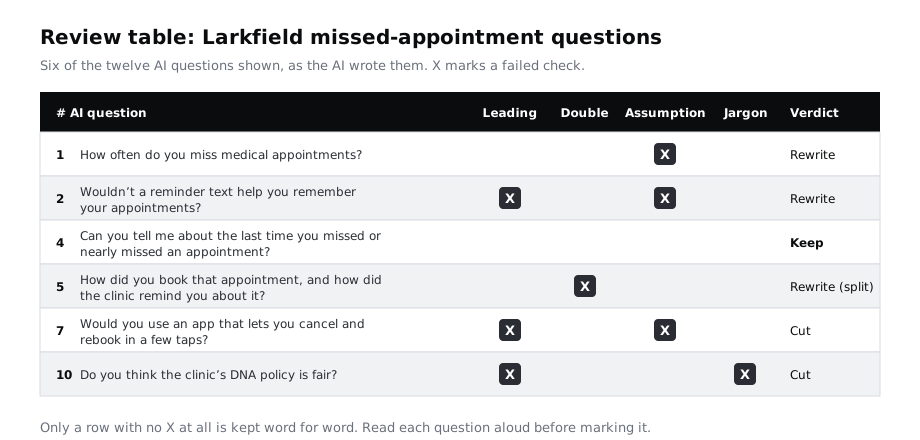
Below the draft, add a table with eight columns: number, AI question, leading, double, assumption, jargon, verdict, and rewrite. Paste each question into its own row. You will mark the four check columns with an X when a question fails that check, and leave them blank when it passes.
The four checks are:
- Leading. The wording suggests an answer, carries a judgement ("frustrating", "easy"), or asks the person to approve an idea. Hypothetical and future questions ("would you use...") go here too: they invite a polite guess.
- Double. The question asks two things, so the person answers whichever half is easier and you lose the other.
- Assumption. The question takes something for granted about the person's life: that they miss appointments often, that they work, own a smartphone, have phone credit, drive, or book only for themselves.
- Jargon. A word the participant may not use or know: clinic terms, research terms or abbreviations.
The verdict column takes one of three words. Keep means all four checks pass and the question stays word for word. Rewrite means it fails at least one check but asks about something your research questions need. Cut means it fails and the topic is not worth keeping, usually because it is about your solution rather than their experience.
Check it worked
Your table has twelve rows, one per question in the unedited draft, and the four check columns and the verdict column are empty. The draft section above it is still untouched.
Step 4 · Check each question for leading wording and double questions
Go down the table once, looking only at the leading and double columns. Read each question aloud as if you were saying it to a patient across a table. Leading wording is much easier to hear than to see.
In the Larkfield draft:
- Question 2 ("Wouldn't a reminder text help...") is leading twice over: "wouldn't" asks for agreement, and it offers the team's favourite solution. Mark leading.
- Question 6 ("How frustrating is it...") hands the participant the word "frustrating". Mark leading.
- Question 7 asks for a prediction about a product they have never seen. Almost everyone says yes. Mark leading.
- Question 10 asks for an opinion on a policy, in a yes-or-no form that invites a quick "I suppose so". Mark leading.
- Question 5 asks how they booked and how they were reminded. Those are two separate stories. Mark double.
Questions 4, 8 and 12 ask about something that happened and carry no judgement words. Leave them blank. Question 9 uses "usually", which asks for a habit rather than a story, but it is neutral and the habit is what you want here, so it passes too.
Do one pass per pair of checks rather than all four at once. When you look for everything at the same time, you notice the loudest fault in each question and miss the quieter one beside it.
Check it worked
Every row has been read aloud. The leading or double column is marked for each question that suggests an answer, contains a judgement word, asks for a prediction or asks two things. For the Larkfield draft that is questions 2, 5, 6, 7 and 10.
Step 5 · Check each question for assumptions and jargon
Go down the table a second time for the other two checks. For assumptions, picture three different participants answering each question: a nurse who works nights, a retired man who shares one basic phone with his wife, and a mother who books for her children and her own mother in two languages. If the question does not make sense for one of them, it assumes something.
In the Larkfield draft:
- Question 1 ("How often do you miss...") assumes missing is a regular habit, and asks for a number people cannot recall accurately. Mark assumption.
- Question 2 assumes the person can receive and read a text. Mark assumption (it is already marked leading; a question can fail more than one check).
- Question 3 assumes there are "barriers" and that the person has already analysed them. Mark assumption. "Barriers" is also research language patients rarely use. Mark jargon.
- Question 6 assumes they phone the clinic and fail to get through. Mark assumption.
- Question 7 assumes they have a smartphone that can run an app. Mark assumption.
- Question 10 uses "DNA", the clinic's code for "did not attend". Mark jargon.
- Question 11 assumes the person works and that work causes the missed appointments. Mark assumption.
Assumptions about phones and data deserve extra care wherever many people use low-cost Android phones, prepaid data or a phone shared within a household, as is common in much of Africa and elsewhere. A question that takes for granted a smartphone, constant data or a private inbox quietly excludes the people most likely to miss appointments. The same goes for language: if you will run some interviews in Yoruba, Hausa, Swahili, Pidgin or any other language, review the translated questions too, with a fluent speaker. A neutral English question can become leading in translation, and AI translations of research questions need the same human check as the English draft.
Check it worked
Every row now has all four check columns considered. For the Larkfield draft, questions 1, 2, 3, 6, 7 and 11 have an assumption mark and questions 3 and 10 have a jargon mark. Only questions 4, 8, 9 and 12 have no marks at all.
Step 6 · Decide a verdict and rewrite the failures yourself
Fill in the verdict for every row. Any question with no marks is Keep. For the rest, ask whether the topic serves one of your three research questions. If it does, the verdict is Rewrite; if it only exists to test your solution or your policy, it is Cut. For a Cut, write a one-line reason in the rewrite column, so anyone reading the table later can see why the question went.
Write each rewrite yourself, in the rewrite column. You can ask the assistant for alternatives if you are stuck, but anything it suggests goes back through all four checks before it enters the guide; a rewritten question is a new draft, not a fixed one. Rewrites usually work the same way: turn a habit or an opinion into a specific past event, remove the judgement word, and ask one thing.
For Larkfield:
- 1, rewrite: "Think of the last appointment you missed or moved. When was that, roughly?" (It sets up question 4 rather than asking for a frequency.)
- 2, rewrite: "Once an appointment is booked, what do you do to remember it?"
- 3, rewrite: "In the days before that appointment, what was going on for you?"
- 5, rewrite as two: "How did you book that appointment?" and, later, "How did you hear about it again before the day, if you did?"
- 6, rewrite: "Tell me about the last time you needed to contact the clinic." Keep "What happened next?" in the guide as a follow-up prompt, to use only if the story stops short.
- 7, cut. It asks about the app, which belongs in a usability test of a prototype, not in an interview about past behaviour.
- 10, cut. An opinion on a policy tells you little about why people miss appointments. If the policy came up on its own, you would follow it with the general prompts in your guide.
- 11, rewrite: "What else did you have on that day?"
Check it worked
Every row has a verdict. Every Rewrite row has a rewrite in the last column, and each rewrite passes all four checks when you read it aloud. Every Cut row has a one-line reason next to it. No Keep row has any mark in the check columns.
Step 7 · Count what survived and assemble the guide
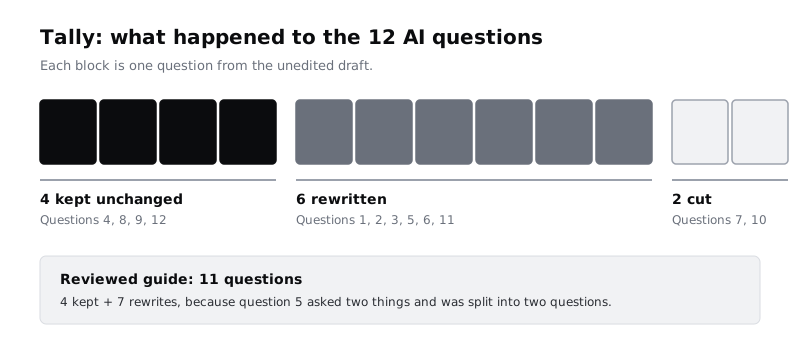
Under the table, add a heading "Tally" and count the verdicts. For Larkfield: 4 of the 12 AI questions kept unchanged, 6 rewritten (question 5 becoming two), and 2 cut. That is a third surviving untouched.
Then write the guide itself under a heading "Reviewed questions". Put the kept questions and your rewrites in an order that tells a story: start with booking, move to the missed appointment and the days before it, then what happened afterwards. Map each question to the research question it answers by writing R1, R2 or R3 after it. A research question with no questions under it is a gap the AI left; write the missing question yourself and add a line to the tally, "added by reviewer".
Keep the tally with the guide. Over a few studies, it tells you how much an AI first draft is really saving you, and which faults your prompts keep producing. If most of your rewrites fix the same assumption, add it to the brief next time ("do not assume the participant works or owns a smartphone") and check whether the next tally improves.
Check it worked
Your document has the unedited draft, the review table, a tally whose kept, rewritten and cut numbers add up to the number of AI questions, and a reviewed list of questions in story order, each tagged R1, R2 or R3. Every research question has at least one question tagged with it.
Next steps
The reviewed questions are the core of an interview guide, not the whole of it.
- Turn them into a full 45-minute guide, with a welcome, warm-up, follow-up prompts and a close, in /tutorials/write-an-interview-guide-without-leading-questions.
- The same four checks apply to survey questions, along with problems specific to answer scales; see /tutorials/write-unbiased-survey-questions-and-scales.
- After the interviews, if you want AI help with the notes, start with /tutorials/remove-personal-data-before-sharing-research-with-ai and then /tutorials/synthesise-interview-notes-with-ai-and-check-it.
Part of these paths
Related tutorials
- Write an interview guide without leading questionsYou will have a 45-minute interview guide built from your research questions, with a warm-up, story-based questions, follow-up prompts and a close, plus a list of leading questions you caught and rewrote.
- Write unbiased survey questions and answer scalesYou will have a corrected set of survey questions, each with an answer scale that fits what it measures and a one-line reason for every change you made.
Need this done for you?
Padding does this work for growing companies, from the first diagnosis to a system that keeps working.
Get new tutorials