Product and project management · Intermediate · 16 min
Run discovery and delivery side by side
By Padding · Updated 18 Nov 2026
Any board tool · November 2026
You will set up a two-track board for a live product, with a written "ready for delivery" rule and a weekly crossing where tested ideas move into the build or are dropped.
On this page
Once a product is live, the hard part is no longer the first big push of research and design. It is the steady stream of ideas that arrive every week: from patients, from staff, from the team's own hunches. Build them all and you ship features nobody uses. Research them all first and nothing ships. Dual-track working runs both at once: one track finds out what is worth building, the other builds it, and a regular gate decides what crosses between them.
The running example is Larkfield Clinic, the fictional community clinic whose online booking is now live and whose appointment reminders are next. The team is a product manager, a designer, two developers and a tech lead, with the practice manager and a receptionist close by. You will sort their work into two tracks, write a test for each untested idea, set up the board, write the rule for what "ready for delivery" means, and run the weekly crossing.
This is different from planning one project with the double diamond, which has phases that end. Dual-track is the rhythm a team keeps after launch, for as long as the product is alive.
Step 1 · Sort what is in flight into learning and building
Open a document called "Larkfield: two tracks". List everything the team is working on or has promised, one line each. Include the half-ideas from the last planning meeting and the requests the practice manager has emailed. For Larkfield the list includes:
- Send an SMS reminder 24 hours before each appointment
- Let patients reply "C" to cancel from the reminder
- A cancel link in the reminder that opens the booking page
- Send reminders in the clinic's second language for patients who prefer it
- A waiting list that offers freed-up slots to other patients
- Nurse appointments bookable online
- Fix the slow open-times page on older Android phones
Now mark each line with one of two letters. B (build) means the team knows enough to build it: the need is shown, the design works, and it is known to be buildable. L (learn) means something important about it is still a guess. Be honest: "the practice manager asked for it" is a reason to look into it, not proof patients need it.
Bugs and small fixes, like the slow page, are B by default. They do not need discovery; they need doing.
Check it worked
Every line in your list has a B or an L. Read out the B items to the team and ask, for each one, "What did we see that tells us this is worth building?" If nobody can name something they saw (an interview, usage data, a test), change it to L. Expect at least a third of the list to end up as L; if none does, you are probably calling guesses facts.
Step 2 · Name the risk each learning item carries
An L item is uncertain in a particular way, and the way decides how you test it. Marty Cagan names four risks a product idea can carry:
- Value: will people use it, or choose it over what they do now?
- Usability: can they work out how to use it?
- Feasibility: can the team build it with the time, skills and technology it has?
- Viability: does it work for the organisation: cost, legal limits, staff time, reputation?
Next to each L item, write the one risk that worries you most. Pick one, even if two apply; you will test the biggest first. For Larkfield:
- Reply "C" to cancel: value (will patients reply rather than ignore it?) and feasibility (can the SMS provider receive replies?). The team picks feasibility first, because if it cannot be built the value question does not matter.
- Cancel link in the reminder: usability (will patients on a small phone find and use the cancel button?)
- Reminders in the second language: value (do patients who prefer that language read reminders more?)
- Waiting list: viability (will receptionists have time to manage it, and does offering slots by SMS fit the clinic's consent rules?)
If you have already ranked assumptions with the team, reuse that grid; the riskiest notes there become your first L items.
Check it worked
Each L item has exactly one risk named next to it, written as a question in the reader's language ("Can the SMS provider receive replies from all local networks?"), not as a label alone. If you cannot write the question, you do not yet know why the item is uncertain; talk to the person who suggested it before going further.
Step 3 · Write the cheapest test for each learning item
For each L item, choose the smallest piece of work that would answer its risk question. Match the test to the risk:
- Value: a few short interviews, a look at existing data, or a fake door (offer the option and count who tries it before building it).
- Usability: a clickable prototype tried by five or so real users on their own phones.
- Feasibility: a spike, where a developer spends a fixed time finding out, and the output is an answer, not production code.
- Viability: a short conversation with whoever owns the constraint (the practice manager for staff time, the person responsible for data protection for consent).
Write each test as a card with four lines: the question, the test, a time box in days, and the pass line. The pass line is what result would count as yes, written before you run it. For Larkfield:
Question: Can our SMS provider receive replies from every mobile network our patients use?Test: Spike. One developer sets up a test number and sends replies from phones on each local network.Time box: 2 days.Pass line: Replies from every network arrive within 5 minutes and can be matched to the booking.
Question: Will patients find and use a cancel link in a reminder on a small phone?Test: Prototype of the reminder and cancel page, tried by six patients in the waiting room on their own phones.Time box: 3 days.Pass line: At least five of six cancel a test booking without help, in under a minute.
Testing on patients' own phones matters for Larkfield. Many use low-end Android handsets on prepaid data, and a cancel page that loads quickly on the office wifi may not load at all on a nearly empty data bundle.
Check it worked
Every L item has a card with all four lines, and every pass line has a number or a yes/no outcome in it. Cover the "Test" line and read only the question and the pass line to a colleague: they should be able to tell you what result would mean "go". If a pass line says "positive feedback" or "users like it", rewrite it with something you can count.
Step 4 · Set up a two-track board
Create a board with two groups of columns side by side. Name the groups, not only the columns, so nobody mistakes one track for the other.
Discovery: To test, Testing, Decide. Delivery: Ready, Building, Live.
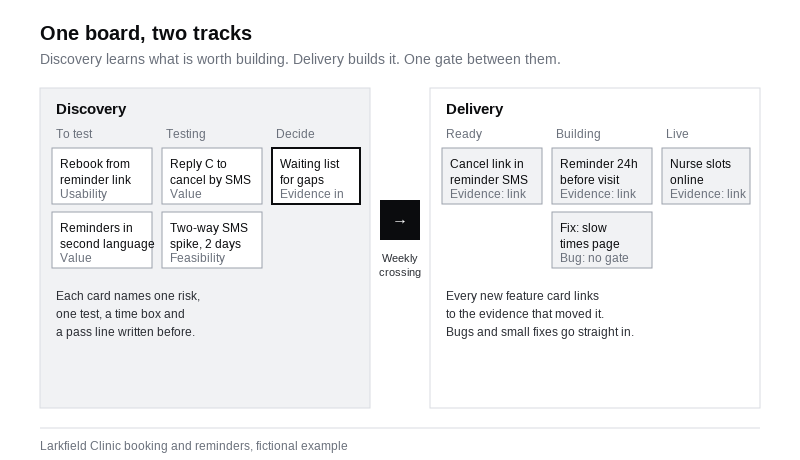
Put each L card in To test, ordered by how much its answer would change your plans. Put each B card in Ready or Building, wherever it really is. Add a field or a line on every Delivery card called Evidence, and leave it empty for now on the B items you inherited.
Limit Discovery to as many tests as the team can actually run at once. For Larkfield that is three: one spike, one prototype test and one conversation. More than that and tests drag on past their time box. If you already run limits on your delivery columns, apply the same habit here.
Check it worked
Your board has both groups of columns with the group names visible. Every L item from your list is a card in To test or Testing, and every B item is in Delivery. Discovery has a written limit on how many cards can be in Testing, and the number of cards there is at or below it.
Step 5 · Write the "ready for delivery" rule
The gate between the tracks needs a written rule, or it becomes "whatever the loudest person wants this week". Write it at the top of the board, or pinned as the first card in Ready. Keep it to a few lines that anyone can check. Larkfield's rule:
A feature is ready for delivery when:1. Its riskiest question was tested and the result met the pass line written beforehand.2. The evidence (notes, recording summary, spike write-up or data) is linked on the card.3. The designer, a developer and the product manager have each seen the evidence.4. It has a thin first slice the team can ship in one sprint.5. We know what we will measure once it is live to see if it worked. >Exempt: bugs, security fixes, small copy changes and anything required by law. These go straight to Ready.
Line 3 is there on purpose. Jeff Patton, who helped popularise the term "dual track", warns against reading it as two teams: one doing research and another building. Discovery and delivery are two kinds of work done by the same people. If the developers never see the evidence, the build will drift from what was learned.
Line 5 closes the loop. Once a feature is live, its measure may raise a new question, and that question becomes a new Discovery card.
Check it worked
Your rule is written where everyone using the board can see it, has no more than six lines plus the exemptions, and each line can be answered yes or no. Pick one card already in Ready and check it against the rule. If it fails, you have found your first real decision for the crossing meeting.
Step 6 · Run the weekly crossing
Book 30 minutes once a week, at the same time, with the whole team. Larkfield uses Thursday morning, before the receptionists' busiest hour. This is the only point where cards cross from Discovery to Delivery.
Go through every card in Decide. For each, the person who ran the test reads the result against the pass line, in a sentence or two. Then the team chooses one of three outcomes:
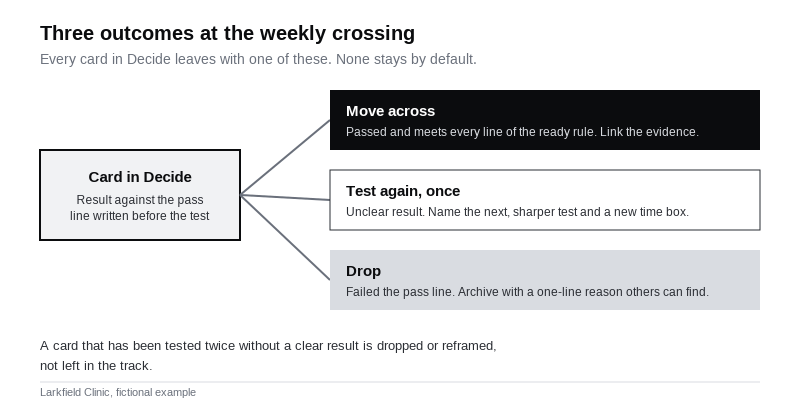
- Move across. It passed and meets the ready rule. Link the evidence on the card and move it to Ready.
- Test again, once. The result was unclear. Write a sharper test, set a new time box, and move it back to To test. A card that is unclear twice is dropped or rewritten as a different question.
- Drop. It failed the pass line. Archive the card with one line saying why, so the idea does not come back next quarter as if it were new.
At Larkfield's first crossing, the SMS spike passed on two networks and failed on a third, where replies took up to an hour. The team dropped "reply C to cancel" and kept the cancel link instead, which had passed the prototype test with six out of six. The cancel link moved across, carrying a link to the test notes.
Spend the last five minutes the other way round: does anything in Delivery raise a question worth a new Discovery card? Add it to To test.
Check it worked
After the meeting, Decide is empty. Every card that left it has a comment saying which outcome it got and why. Count the outcomes: if every card moved across, your pass lines are too easy, or you are only testing ideas you already believe in. Dropping some ideas is the track doing its job.
Step 7 · Share the team's time between the tracks
Both tracks need the same people, so agree how time is split, or delivery deadlines will quietly eat discovery. A starting point that works for many small teams is that discovery takes a fixed slice of each week, and the product manager and designer spend more of their time there than the developers do.
Write the split on the board, by role. Larkfield's:
- Product manager: about half the week on discovery
- Designer: about half on discovery, half on delivery
- Tech lead: one day a week on spikes and test reviews
- Developers: take turns on spikes; each joins at least one patient session a month
The last line matters most. Developers who have watched a patient try to cancel on a cracked phone screen make different decisions from developers who read about it.
Review the split at the end of each month. If discovery tests keep running past their time boxes, it is too small. If Ready has more cards than the team can build in a month, discovery is ahead; move time back to delivery.
Check it worked
Your board shows a written time split for each role, and every developer's name appears against at least one patient session or spike in the coming month. Look at the last four weeks: the number of cards that crossed should be roughly what the team built in that time. A Ready column that keeps growing, or one that is always empty, tells you which way to adjust.
Step 8 · Audit the board for evidence
After two or three crossings, check the board does what it is meant to. Go through every feature card in Ready, Building and Live, and open its Evidence link.
For each, ask three things:
- Does the link open, and does it show the test result, not a plan or a slide of hopes?
- Does the result match the pass line on the Discovery card it came from?
- Is the exemption honest? A "small copy change" that adds a new screen is not exempt.
For the B items you inherited at the start with an empty Evidence field, either find the evidence and link it, or write "built before dual-track; measure after launch" and add what you will measure. Do not pretend those had discovery they did not have.
Check it worked
Every feature card in Delivery either links to the evidence that moved it across or is marked as an exemption or an inherited item. Pick three cards at random and open their links in front of a teammate: each should take under a minute to show why the team is building it. If one cannot, move it back to Discovery and test it at the next crossing.
Next steps
If your team does not yet have a ranked list of assumptions to feed the Discovery track, start with Map your assumptions and choose which to test first. For the value tests, Run your first user interview shows how to talk to patients without leading them. To keep the Delivery side flowing once cards cross, set limits on it with Run a Kanban board with WIP limits. When a new product area needs a full research phase before any of this starts, plan it with Plan a project with the double diamond.
Related tutorials
- Write user stories with clear acceptance criteriaYou will have five user stories for a clinic's reschedule feature, each checked against INVEST and carrying Given / When / Then acceptance criteria that a developer and a tester read the same way.
- Write tickets developers want to pick upYou will rewrite three vague backlog tickets into ones a developer can start without asking a question, and save the structure as a ticket template in your tracker.
- Write a weekly stakeholder update people readYou will have a reusable weekly update template and one finished update under 250 words, whose first two lines tell any reader whether they need to act.
Need this done for you?
Padding does this work for growing companies, from the first diagnosis to a system that keeps working.
Get new tutorials